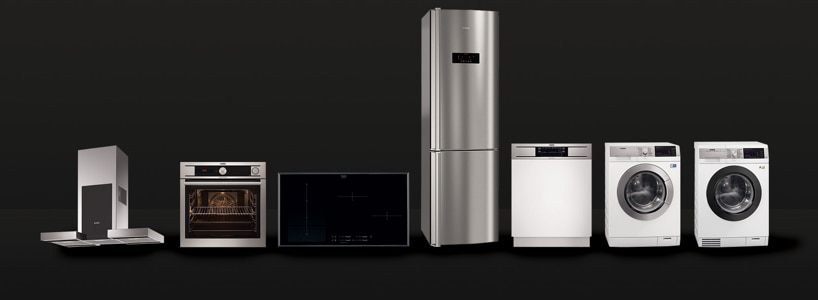
It may seem incredible today, but there was a time when industrial production was purely functional. Artistic merit and aesthetic sense were largely irrelevant in mass-produced goods; there was little harmony between form and function. At least, that was how it was until 1907, when a certain architect was appointed Artistic Consultant to AEG.
Allow us to introduce Professor Peter Behrens – a designer from Germany.
Behrens embodied a wide range of talents and was also a visionary. A Renaissance man in the true sense of the word, he moved with ease between several disciplines: painting, graphic design, architecture, and furniture design. Behrens worked with, and was an inspiration to, some of the biggest names in Modernism, including one Walter Gropius, founder of the Bauhaus school.
When Behrens came to AEG, he brought with him a simple but powerful design philosophy that was to be the enduring hallmark of the AEG company and its products.
The paradigm shift that Behrens affected in AEG and in the self-conception of German industrial design as a whole was based on the notion of developing electrical household appliances with an eye both to aesthetics and the specific function of the object. To quote Behrens himself: “Design is not about decorating functional forms - it is about creating forms that accord with the character of the object and that show new technologies to advantage.”
But product design was just the beginning. Behrens went on to embed himself and his design approach in the whole corporate culture. He designed factories that were tailored to the individual requirements of AEG and its workers; he created not only the company logo, but the company’s whole corporate identity, including numerous advertising campaigns.
In today’s world, we are surrounded by strong, easily-recognisable brands. But it was not always like this.
It was Behrens’ creativity that first established the “corporate identity” concept as the basic element of the philosophy of an industrial company and its brands.
So it is no surprise that Behrens changed the form of functional objects in a way that is still visible today – in the outstanding concepts developed by top designers at AEG.
The AEG design team combines a range of creative talents. Each person brings their own unique influences to the table, but all work together towards Peter Behrens’ goal of designing every electrical appliance to be “perfect in form and function”. 100 years after Peter Behrens first joined the company, this powerful source of inspiration is still alive and kicking – and still bringing forth a whole range of impressive innovations.
The induction hob, for example. This hob system has four cooking zones and takes every size of pot in every possible position. So the hot area of the cooking zone automatically adapts itself to the size of the pot – not the other way around.
Or how about the heat-pump tumble-dryer, which gently blows warm air through the laundry in a closed cycle and uses a condenser to filter out moisture.
This is product design for the 21st century, inspired by an outstanding figure in the history of Germany and of AEG: Peter Behrens – the founder of industrial design and the spiritual father of today’s AEG design team.
Peter Behrens is appointed Artistic Consultant at AEG and becomes the world’s first industrial designer. |
|
||||||
The “Dandy” vacuum cleaner enters the market - simply to use, with better suction and air filters. |
|
||||||
The birth of the first fully-automatic washing machine – the LAVAMAT. |
|
||||||
The FAVORIT dishwasher is presented to the world. |
|
||||||
AEG brings the first fully-electronic oven to the market. |
|
||||||
AEG produces the first CFC-free refrigerators and freezers. |
|
||||||
AEG re-designs all its products in the “Neue Klasse” look, which emphasises harmony of form and function. |
|
||||||
100 years of inspiration are behind us – and the next 100 are just beginning. |
|
||||||